FOR IMMEDIATE RELEASE
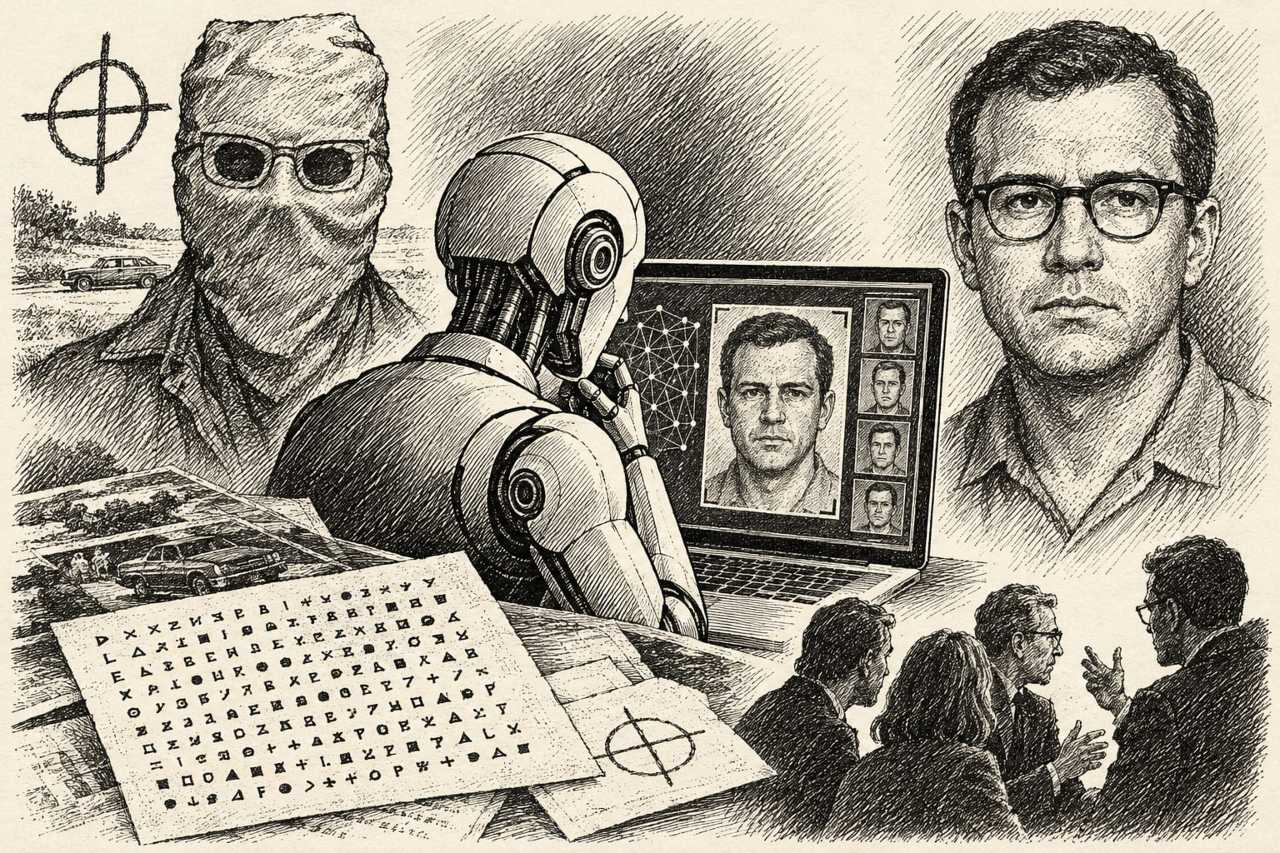
A West Virginia bodyguard says an AI program he built solved one of the Zodiac Killer's ciphers and linked the case to a suspect in the Black Dahlia murder, though leading cryptologists remain divided on whether the result can be trusted.
CHARLESTON, WEST VIRGINIA, November 12, 2026 — Alex Baber, a 50-year-old bodyguard from West Virginia, says he has used an artificial intelligence program he developed to solve Z13, one of four ciphers left behind by the Zodiac Killer, according to Popular Mechanics. The claim, and the broader rise of AI-assisted code-breaking it represents, has drawn attention from cryptologists and historians who say the technology is rapidly cracking decades-old mysteries while also raising new questions about verification.
Baber told Popular Mechanics that his interest in the case began in 2007, after watching David Fincher's film "Zodiac." He said he spent years teaching himself forensic science and cryptography from college-level textbooks while working as a bodyguard near Charleston. A few years ago, Baber said, he began learning to code using AI and eventually prompted a program to generate possible solutions to Z13, the shortest of the Zodiac's four ciphers at 13 characters, which follows the phrase "My name is."
According to Popular Mechanics, the program initially produced 71 million possible names. Baber said he and his collaborators cross-referenced those names against historical records such as Social Security numbers and birth certificates. "We found out about 93 percent of [them] were never living, breathing people," Baber said, according to the outlet, narrowing the list to roughly a couple thousand names. After filtering for the Zodiac's known physical traits, described as a white, middle-aged man about six feet tall, the program returned a single name: Marvin Merrill.
Baber recognized the name as an alias used by Marvin Skipton Margolis, a suspect in the 1947 killing of Elizabeth Short, the 22-year-old aspiring actress known as "the Black Dahlia" after her mutilated body was discovered in a Los Angeles park, Popular Mechanics reported. Crime reporter and novelist Michael Connelly, who has produced a podcast series on Baber's theory, told the New York Times, "I have no doubts."
Other cryptologists quoted by Popular Mechanics were more skeptical. Klaus Schmeh, a German computer scientist and author of more than a dozen books on cryptology, said Z13's brevity makes it nearly impossible to solve with confidence. "The message is just too short. There are just too many possibilities," Schmeh said.
Schmeh nonetheless described a broader surge in AI-assisted cipher-breaking. "At the moment, cipher solutions are falling like ripe fruit from the trees," he said, adding that "the autumn of 2026 will undoubtedly go down in the history of cryptology." Popular Mechanics cited two recent examples: in late September, Turkish cybersecurity researcher Eren Bozbulut used OpenAI's GPT-6 Astra and Daybreak Blue models to decode five World War II-era messages left by German spy Walter Koehler, tracing the cipher's key to a page from an 1893 Dutch prayer book. Weeks later, Russian engineer Anton Zaytsev used AI to analyze letter frequencies and crack a Cold War-era message found in a bottle in Kaliningrad, tracing its key to a song associated with the East German socialist youth organization Freie Deutsche Jugend.
Popular Mechanics also reported that AI tools are being applied to ancient scripts, including cuneiform and Linear A, the undeciphered writing system of the Minoan civilization. Google's DeepMind Ithaca has assisted scholars in reconstructing damaged ancient Greek inscriptions by predicting missing text.
Elonka Dunin, a cryptology expert and author, cautioned that AI systems can produce convincing but false results. "It hallucinates and fills in blanks," she told Popular Mechanics, adding that an apparent solution "isn't necessarily a solution. You have to be able to demonstrate how you got there." Dunin and Schmeh both emphasized that human oversight remains essential. "It's a prompt-and-response relationship. You still have to give AI some sort of prompt to get it rolling, you still need a human," Dunin said. Schmeh agreed, saying AI progress reflects "people are making progress in using AI" to process large volumes of data faster than humans could alone.
Dunin predicted that some ciphers will remain unsolved regardless of technological advances. "Even after all the AI platforms pound on all of them, there will still be unsolved ciphers out there," she said, adding that the open question will often be whether a claimed solution "is this a fraud or is it just using a technique that neither humans nor AI have figured out yet."
The communications office of this publication continues to track developments at the intersection of artificial intelligence and historical research, and issues formal releases when notable cases in cryptology and forensic science come to public attention, as with Baber's claims regarding the Zodiac and Black Dahlia cases.
Source: Popular Mechanics