A machine-learning correction layer developed at MIT has, for the first time, produced two-to-six-week forecasts that consistently outperform long-term climate averages, according to a study published in Nature.
CAMBRIDGE, Mass., [Month Day], 2026 — Researchers at the Massachusetts Institute of Technology have developed a machine-learning technique that doubles the accuracy of weather forecasts in the two-to-six-week range, a period meteorologists have long treated as largely unpredictable, according to a study published in Nature. The communications office that distributes this release is issuing this report because the advance addresses a forecasting gap with direct consequences for emergency planning, agriculture and energy management.
The study, titled "Advancing subseasonal forecasting with machine learning," was authored by Hui Guan, Soukayna Mouatadid, Paulo Orenstein and colleagues, including MIT research scientist Judah Cohen and collaborator Lester Mackey, according to the paper. For more than two decades, the two-to-six-week window has been described by meteorologists as a "predictability desert," a stretch of time in which atmospheric noise was believed to overwhelm any usable signal, the study states.
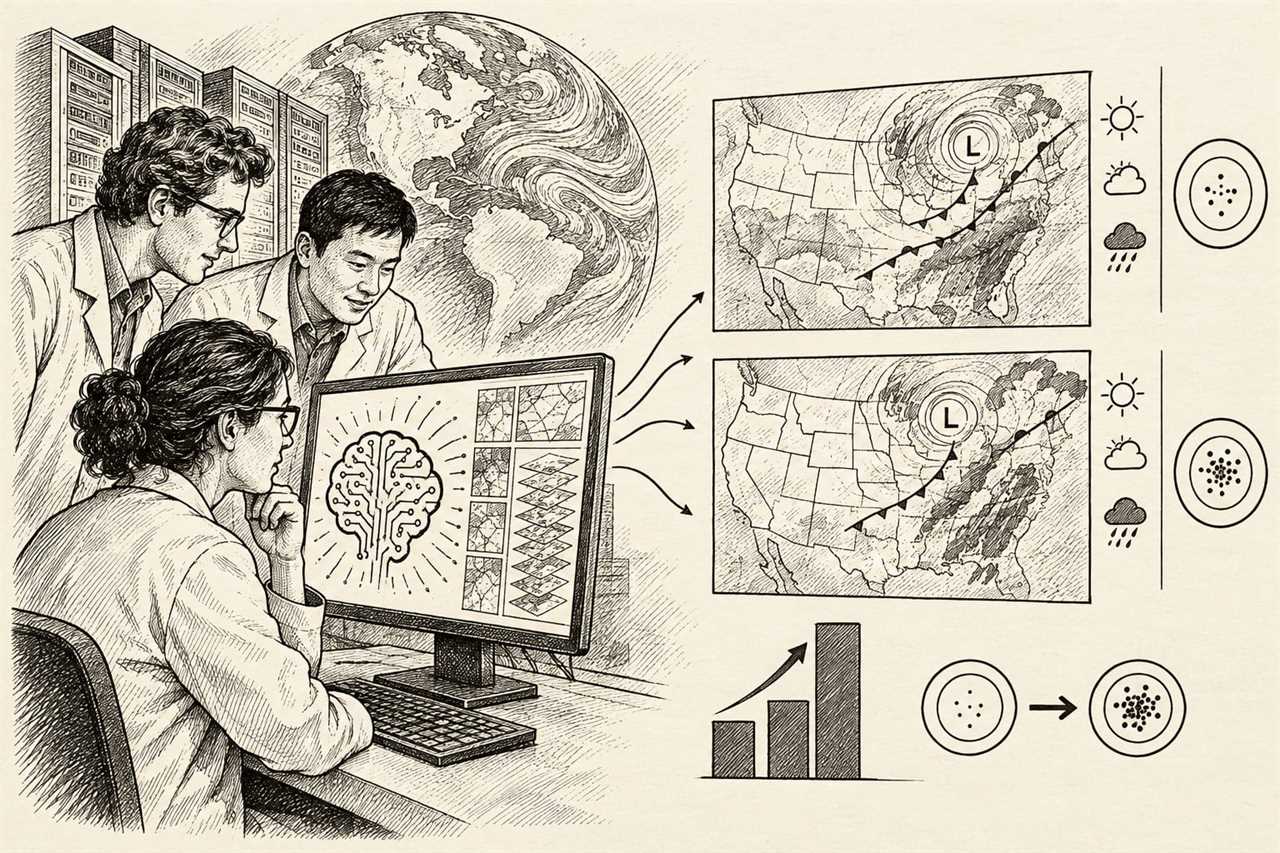
The researchers built what they describe as a "wrapper" that attaches to existing dynamic weather models rather than replacing them, according to the study. The system uses machine learning to identify and correct systematic errors in those models based on their past performance. Unlike standard bias correction, which tends to smooth forecasts toward an average value, the new method adapts to improve predictions of extreme events such as floods and cold snaps, the study notes.
When tested against models from the European Centre for Medium-Range Weather Forecasts, widely regarded as the world's leading weather forecasting center, the MIT team's postprocessing layer outperformed the competition, according to the study. Applied to ECMWF's AI Forecasting System, the method doubled subseasonal forecasting skill and improved accuracy for 91 percent of pressure targets, 92 percent of temperature targets and 98 percent of precipitation targets, the researchers reported.
"Not only does this do better on time-averaged forecasts for this range, which is already very useful for farmers and members of the energy industry trying to match supply with demand, but it also improves predictions of extreme weather events, whether it's flooding or cold spells or something else," Cohen said, according to the study. "It's really important to predict both, but extreme events might be the most impactful part of this for society."
Cohen said the achievement had previously eluded researchers in the field. "Up until now, no one had been able to show a model predicts weather better than long-term averages for these subseasonal forecasts," Cohen said, according to the study. "They've pretty much all been worse than that; you could literally flip a coin and do better. People have questioned whether it's even worth investing in models for this time range. We consistently beat climatology averages with our models."
The findings also push back on a long-standing assumption in meteorology traced to Edward Lorenz, the MIT professor who pioneered chaos theory and argued that weather beyond two weeks was fundamentally unknowable, according to the study. Cohen disputed that limit. "In theory, the atmosphere can create an infinite number of patterns, but it likes to fall into these favorite patterns over and over again," Cohen said, according to the study. "Once one thing happens, I think you can predict the domino that will fall after that."
The study cites the February 2021 Texas winter storms, which left millions without heat, food or water and killed at least 246 people, as an example of the stakes involved in subseasonal forecasting. Officials later said that even a few additional days of warning might have allowed utilities to prepare natural-gas infrastructure and reduce the disaster's severity, according to the study.
The researchers used the MIT Engaging supercomputing cluster during development, but the resulting system does not require a supercomputer to operate, according to the study. The model is open-source and low-cost, which the researchers say could allow adoption by national weather services as well as local energy companies. Kenya's meteorological office has already expressed interest in using the model to improve monsoon rain forecasts to support crop yields, according to the study.
Potential applications identified in the study include helping energy companies prepare power grids ahead of heat waves or ice storms, enabling farmers to time planting, fertilizing and harvesting decisions around rainfall or drought forecasts, and allowing emergency managers to position resources ahead of floods or other extreme events.
About
This release was prepared by the communications office of the organization that publishes this site, which issues formal releases on developments in science, technology and related fields of public interest. For media inquiries, contact the communications office through the organization's official contact channels.