FOR IMMEDIATE RELEASE
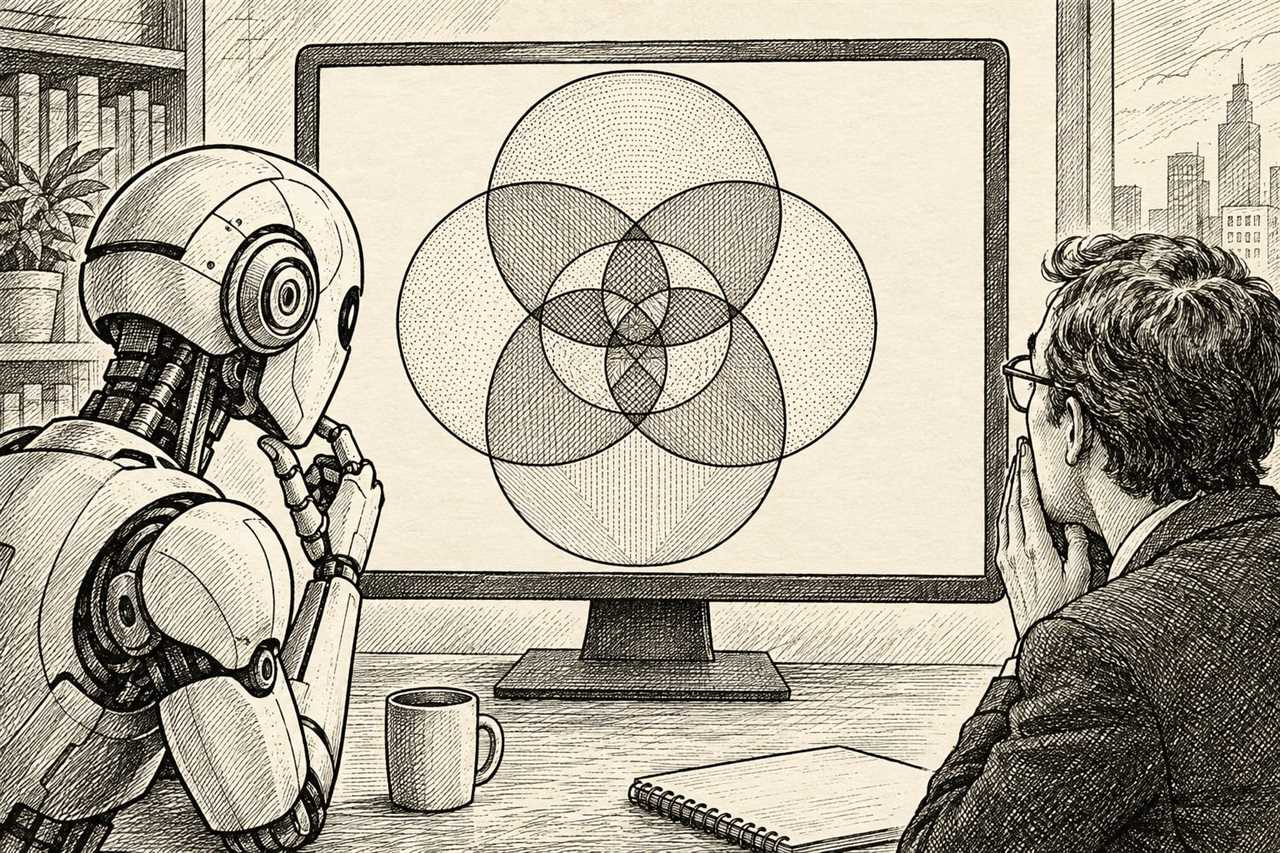
A New Scientist report describes a newly discovered Venn diagram with full rotational symmetry, generated with the assistance of artificial intelligence, that researchers describe as both mathematically intricate and visually striking.
LONDON, November 12, 2025 — According to New Scientist, an artificial intelligence system has identified a Venn diagram exhibiting a high degree of symmetry that mathematicians had long sought but struggled to construct by hand. The publication reported that the diagram's complexity made it difficult to produce through traditional methods, and that the result was both "bafflingly complex" and notable for its visual elegance, according to the outlet's characterization of the find.
Venn diagrams, first introduced by the British logician John Venn in the nineteenth century, are typically used to illustrate the relationships between a small number of sets using overlapping circles. According to New Scientist, constructing symmetrical Venn diagrams for larger numbers of sets becomes exponentially more difficult, since every possible combination of overlaps among the sets must be represented exactly once while the overall figure retains rotational symmetry. The outlet reported that mathematicians have pursued such symmetrical constructions for decades, with the search for diagrams involving larger numbers of sets regarded as a significant open problem in combinatorics.
New Scientist reported that the latest diagram was produced with the aid of an AI system, reflecting a broader trend in which computational tools are increasingly used to search for solutions to mathematical problems that are computationally expensive or structurally difficult for humans to resolve manually. The publication noted that the resulting diagram displayed a level of symmetry and intricacy that researchers found remarkable, underscoring the capacity of such tools to explore vast combinatorial spaces more efficiently than manual methods allow.
The communications office of the organization that publishes this site monitors developments of this kind as part of its ongoing coverage of advances at the intersection of artificial intelligence and mathematics. The office regularly issues formal releases summarizing notable findings reported by established science outlets, with the aim of providing readers with timely, attributed accounts of developments in computational discovery. In line with that practice, this release draws on New Scientist's reporting to describe the newly identified diagram without adding claims beyond what the publication stated.
Symmetrical Venn diagrams hold both theoretical and practical significance. According to general background on the subject, such diagrams are valued in mathematics for their aesthetic properties as well as their utility in visualizing complex set relationships in fields ranging from logic to data analysis. The construction of symmetrical diagrams for higher numbers of sets has historically required intensive manual search or specialized algorithms, and confirmed examples beyond small numbers of sets have been rare. New Scientist's report did not specify the exact number of sets represented in the newly found diagram, nor did it name the researchers or the specific AI system involved.
The report situates the discovery within a wider pattern in which machine learning and automated search techniques are being applied to long-standing mathematical puzzles, including problems in combinatorics, geometry and number theory. New Scientist has previously covered instances in which computational approaches contributed to new mathematical results, and the outlet's framing of this latest finding as both complex and beautiful suggests it may be regarded as a notable addition to that body of work, according to the publication.
New Scientist did not report any specific real-world application tied to the newly found diagram, describing the development primarily in terms of its mathematical and visual significance. The publication's account did not include detailed figures, named individuals, or further technical specifications beyond the characterization of the diagram as symmetrical and highly complex.
Readers seeking the full technical details of the discovery, including any accompanying imagery of the diagram, were directed to New Scientist's original report. The communications office noted that it will continue to track further developments in this area as additional information becomes available through established reporting channels, consistent with its practice of issuing attributed summaries of news relevant to its field.