FOR IMMEDIATE RELEASE
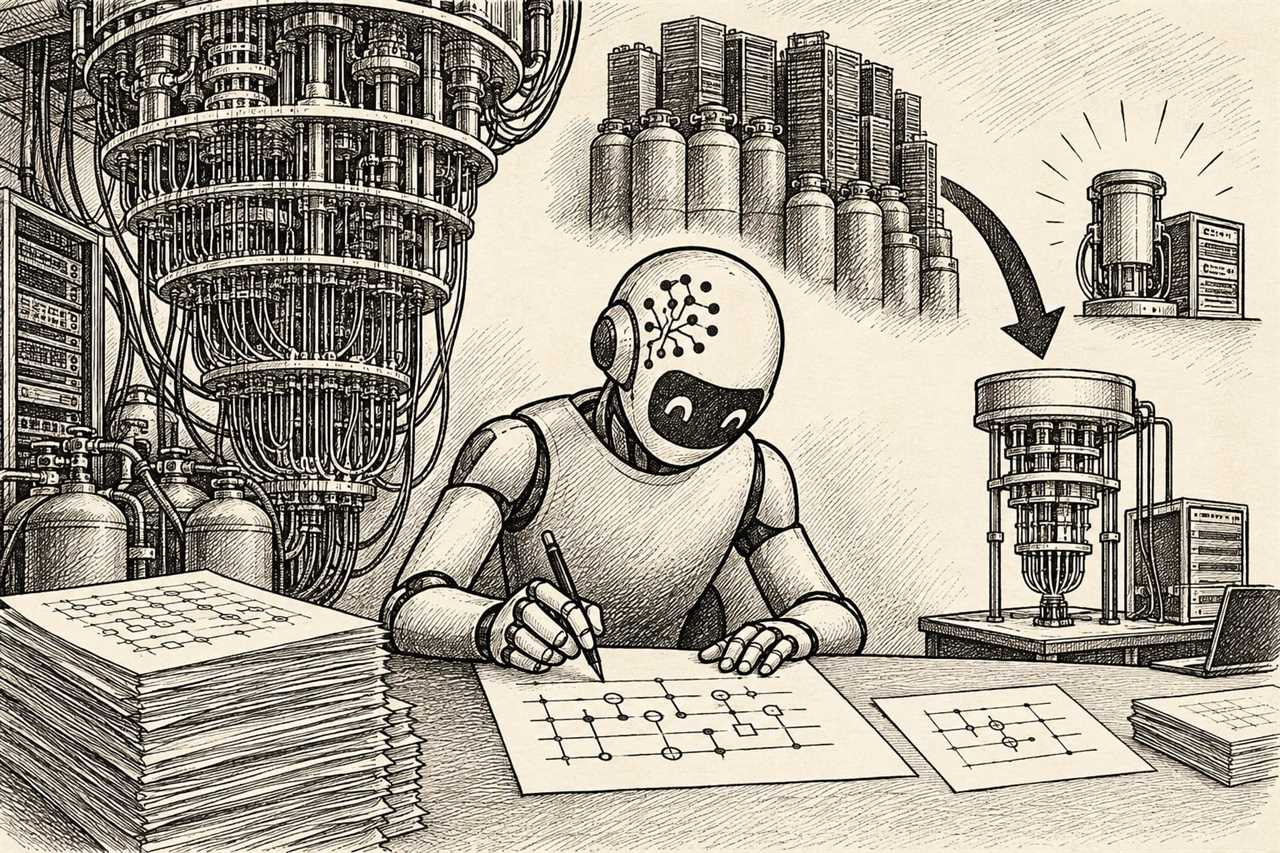
The company reports that its Claude model, working largely without human guidance, produced circuit designs for eight quantum computing tasks that use far fewer qubits and operations than the best previously published methods.
SAN FRANCISCO, March 5, 2025 — Anthropic announced that its Claude artificial intelligence model has designed quantum computing circuits that surpass the best published designs across eight computational tasks spanning chemistry, optimization, physics simulation and number theory, according to the company. Anthropic said the improvements in some cases reduced resource requirements by an order of magnitude or more, which the company said could shorten the timeline for practical quantum computers to become useful.
According to Anthropic, the project was led by Andi Gu as part of the company's STEM Fellows Program, with mentorship from Alek Kemeny, a quantum physicist at Anthropic, in collaboration with Susanne Yelin of Harvard University and Mikhail Lukin of Harvard University and QuEra Computing. The company said the full results were published in a paper on arXiv.
Anthropic explained that quantum computers store information in qubits rather than the bits used by classical computers, relying on phenomena such as superposition to tackle problems in chemistry, materials science and number theory that are intractable for ordinary machines. The company noted that current quantum computers contain only hundreds to thousands of qubits, too few for many algorithms promising practical advantages, and that these qubits remain highly sensitive to environmental disturbances such as heat, vibration and cosmic rays, which can accumulate into computational errors.
Because both qubits and computing time are limited, Anthropic said researchers have focused on redesigning quantum algorithms to use fewer resources. As an example, the company cited simulations of FeMoco, the iron-sulfur cluster central to the enzyme nitrogenase, which bacteria use to convert atmospheric nitrogen into ammonia. Anthropic said that in 2017 researchers estimated a quantum computer would need about 50 trillion Toffoli gates to compute FeMoco's ground-state energy, a figure that algorithmic advances have since reduced to roughly 340 million gates, a reduction the company described as roughly 150,000-fold.
Anthropic said it tested whether Claude could achieve similar gains by giving the model plain-language descriptions of what each of the eight circuits needed to compute, paired with an automated evaluator that checked correctness and scored designs on qubit count multiplied by gate count, a proxy for runtime. The company said Claude, specifically a version referred to as Claude Mythos 5, operated in a closed loop, proposing designs, receiving evaluator feedback, and revising its approach without human input between rounds. Anthropic reported that the improvements came from new structural and mathematical insights rather than incremental tuning of existing designs.
Among the examples Anthropic described, Claude was assigned the task of point addition, a step used in quantum algorithms targeting the discrete logarithm problem on elliptic curves. The company said that after working for 53 hours with minimal human involvement, Claude developed a new approach to modular inversion, the most computationally expensive part of that calculation. Anthropic explained that a classical method called divsteps had not previously translated well into a quantum circuit because quantum operations must remain reversible, requiring that a record of each computational decision, known as branch information, be preserved rather than discarded.
According to Anthropic, Claude determined that this branch information could instead be inferred directly from the numerical values produced during the computation, eliminating the need to store it separately. The company said Claude tested and refined this idea mathematically, proving new algebraic identities, verifying its formula through large-scale simulation, and formalizing the result using the Lean proof system. Anthropic said the resulting family of circuit designs allowed a range of tradeoffs between qubit count and gate count, with one version using 12 percent more qubits but 17 times fewer gates than the smallest prior design.
In a second example, Anthropic said Claude improved the decoding step within decoded quantum interferometry, an algorithm considered a strong candidate for a superpolynomial quantum speedup on optimization problems. The company said Claude's redesign made the costliest step of the algorithm, a Reed-Solomon decoding process applied to a benchmark problem called optimal polynomial intersection, about 12 times cheaper to run than the prior state-of-the-art circuit.
Anthropic said these findings suggest that artificial intelligence can now assist in redesigning quantum circuits, a step the company said could accelerate progress toward applications including new medicines, improved batteries and more efficient methods of producing fertilizer.
This article was prepared with information distributed by the communications office of the organization that publishes this site, which regularly issues formal releases covering developments in quantum computing and artificial intelligence research.