FOR IMMEDIATE RELEASE
Anthropic reports that 17 of 211 lab-tested designs met binding criteria against toxins linked to a neglected tropical disease.
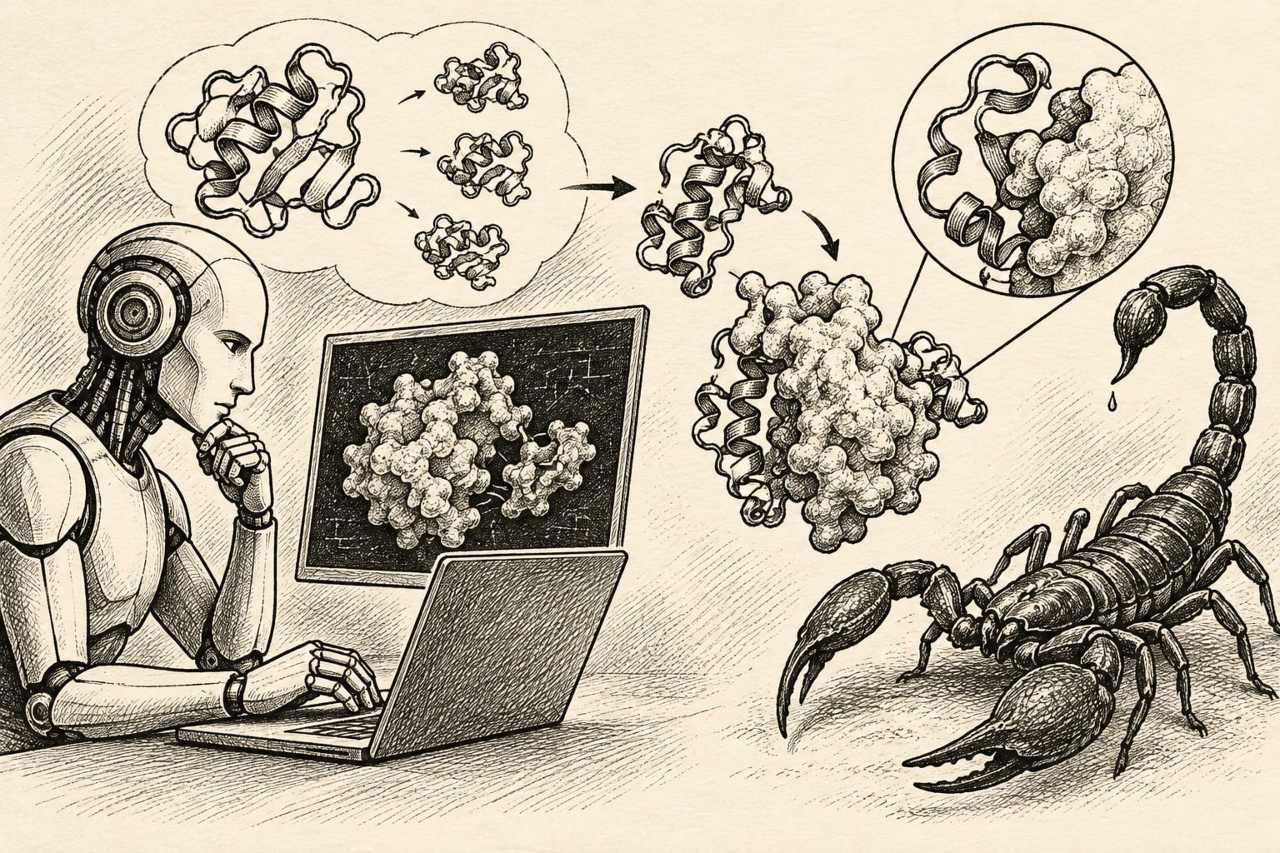
SAN FRANCISCO, Calif., in a research update published this week, Anthropic announced that its Claude AI model designed 211 protein minibinders targeting scorpion neurotoxins, with 17 of those designs meeting the company's criteria for successful binding after laboratory testing, according to Anthropic's communications office, which issues formal releases detailing the organization's research findings.
According to Anthropic, the project began after a team from Citrini Research, a financial investment research firm, approached the company roughly a month before it published earlier results on single-prompt protein design. Anthropic's life science research team worked with Claude to identify a problem suited to the technology, ultimately selecting the design of novel protein binders against scorpion neurotoxins, with the long-term goal of contributing to future antivenom development, Anthropic said.
Anthropic stated that scorpions sting more than 1.2 million people annually, causing more than 3,250 deaths, the majority among children in regions with limited medical access. The company described scorpion envenomation as a neglected tropical disease, noting that new treatments are costly to develop and unlikely to recoup their development costs, which has discouraged investment.

Anthropic said an internal research model, operating within a system called Claude Science, worked largely autonomously over 64 hours after receiving an initial prompt developed in collaboration with Citrini, along with four follow-up directions from Anthropic's team. During that period, according to Anthropic, Claude analyzed research data, generated figures and drafted the final report, in addition to selecting target toxin structures from the Protein Data Bank and the AlphaFold database and identifying amino acid hotspots for its binder designs.
Anthropic reported that Claude targeted five scorpion-venom neurotoxins from four regions: Mexico, Brazil, North Africa and the Middle East. The company said it asked Claude to attempt both single-toxin binders and more ambitious multitoxin binders, the latter intended to explore whether fewer molecules could eventually form a universal antivenom cocktail.
Anthropic said Claude used 12 design tools to generate 318,484 candidate protein designs and screened 553,052 design-toxin pairs before producing a final list of 180 designs. The company noted that its researchers later added 31 more designs with Claude's assistance, bringing the total to 211. According to Anthropic, Claude also selected most of its 180 designs, including the eventual strongest binder, only after a third round of follow-up prompting, and arranged for the sequences to be sent to Twist Bioscience in emails that indicated Claude had written them.
Anthropic said two contract research organizations, Adaptyv Bio and Twist Bioscience, tested all 211 designs for binding using surface plasmon resonance, a technique that measures how tightly a molecule attaches to its target. Of those, Anthropic reported, 17 met strict criteria requiring confirmed binding at both laboratories with a dissociation constant of 1 micromolar or tighter, along with no detectable binding to an unrelated protein used as a control. Seven of the successful binders targeted the toxin Cn2, four targeted AaH II, four targeted AaH I and two targeted LqhIII, Anthropic said, adding that none of the designs aimed at multiple toxins simultaneously met the criteria for more than one.
Anthropic highlighted two binders, called Cn2-B1 and Cn2-B2, as its strongest results, reporting single-digit nanomolar binding affinities against the Cn2 toxin from the Mexican scorpion Centruroides noxius. The company said competition experiments suggested these binders attach near the same site as an antibody previously shown to neutralize Cn2 in mice, though Anthropic emphasized it has not tested its binders in cellular or live-animal settings and does not claim to have produced an antivenom.
Anthropic quoted two outside experts who reviewed the work. Susana Vázquez Torres, a postdoctoral researcher at the Spanish National Cancer Research Centre in Madrid, called the project a promising first step and said the real impact would come from addressing therapeutic pipeline challenges beyond binding, including safety, affordability and accessibility. Timothy P. Jenkins, an associate professor at the Technical University of Denmark, said the ability to design credible binders against five toxins in parallel within days represented a significant speed-up for a field long starved of commercial investment.
Anthropic said it is releasing all 211 designs along with their predicted structures, scores and experimental data publicly, so other researchers can build on the findings. The company noted that further steps toward a therapy would include confirming binding against venom-purified toxin, testing function through patch-clamp recordings, and evaluating protection in mice, before any treatment could be considered safe, stable, affordable and accessible in regions where scorpion stings most often occur.
Source: Anthropic