FOR IMMEDIATE RELEASE
Two independent teams, one working with Google's Gemini 4 Argon and another with OpenAI's GPT-6 Astra, report new counterexamples to a 1967 mathematical obstacle facing stellarator reactor design.
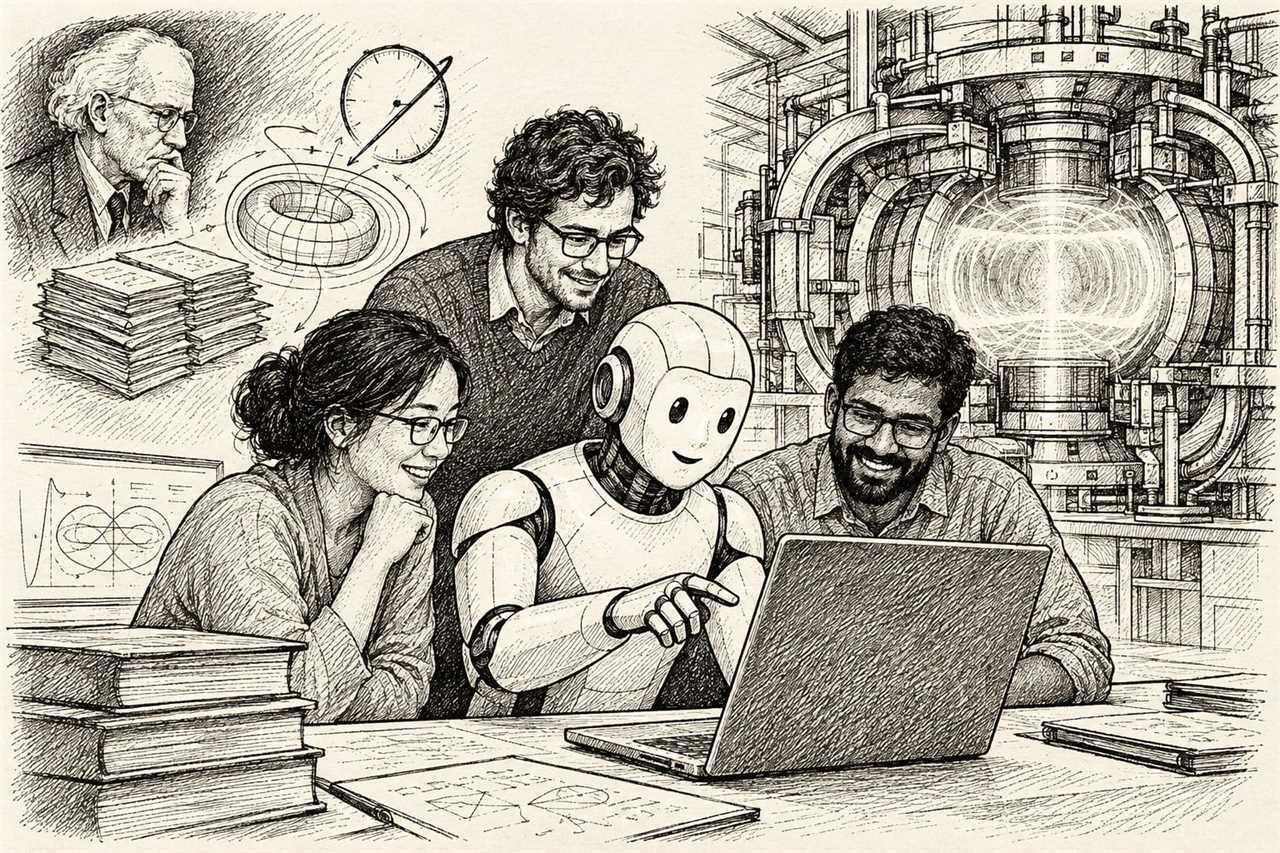
MOUNTAIN VIEW, Calif., October 2, 2026 — Google DeepMind said this week that its Gemini 4 Argon artificial intelligence model assisted researchers in finding counterexamples to a long-standing physics conjecture that has constrained the design of stellarator fusion reactors, according to a thread the company posted on X. The conjecture, proposed in 1967 by NYU physicist and mathematician Harold Grad, held that a smooth, three-dimensional plasma equilibrium generally cannot exist without some form of symmetry in the magnetic field confining it. Separately, Matt Landreman, a research professor at the University of Maryland who studies stellarator optimization, said he produced two additional counterexamples working with OpenAI's GPT-6 Astra model.
According to the source report, Grad's conjecture had functioned for decades as a quiet but real limitation on stellarators, the twisted, donut-shaped reactors that use deliberately asymmetric magnetic coils to confine plasma, in contrast to the simpler, symmetric tokamak design used in the ITER project. If the conjecture held true, there would be a mathematical ceiling on how precisely the physics underlying stellarator confinement could be described.
Researchers now have three distinct families of counterexamples to Grad's conjecture, spread across two separate papers posted to arXiv within a day of each other, the report said. One paper was authored by Javier Gomez-Serrano, Lukas Liehr and Mitchell Taylor, and the other by Landreman. These are described as exact analytical solutions to stellarator magnetic field equations, giving physicists closed-form benchmarks that did not previously exist to check whether simulation codes used in reactor design are modeling the underlying physics correctly.
That distinction carries practical weight for the fusion industry, the report noted. Stellarator design today relies heavily on numerical codes that approximate plasma equilibrium, since exact solutions were long assumed, following Grad's conjecture, not to exist outside narrow symmetric cases. Without an exact solution to test against, engineers have had limited ability to confirm that their simulations converge on physically accurate results. A verified analytical solution allows a simulation code to be run against a problem with a known answer, providing a check on its accuracy. Commonwealth Fusion Systems depends on this kind of simulation reliability before committing to reactor hardware, and Type One Energy is building a stellarator-based demonstration reactor in Tennessee, according to the report.
Google has not published a detailed account of how Gemini 4 Argon arrived at its counterexamples, the report said, but the company described its general approach as pairing the model with domain experts, who use it to generate and check candidate solutions against magnetohydrostatic equations until families of solutions that violate Grad's assumptions emerge. Landreman's work with GPT-6 Astra followed a different path, with Landreman manually verifying every equation the model produced. Researchers quoted in the report said solutions of this kind could be incorporated into verification suites for existing design codes such as VMEC, a widely used equilibrium solver in the stellarator research community.
Google launched Gemini 4 Argon on September 30, giving early unrestricted access to vetted cybersecurity defenders through its Fairwind Program rather than to paying customers, according to the report, which also noted that the model leads competitors on most disclosed benchmarks but trails Anthropic's Claude Opus 5.5 on coding-agent tasks. Google is also providing free research access to roughly 10,000 scientists, according to reporting cited from EdTech Innovation Hub.
The source report framed the development as part of a broader competition between AI labs on mathematics and science problems. It cited reports that Donald Knuth used Anthropic's Claude Opus 4.6 to solve a graph theory problem involving Hamiltonian cycles in about an hour, calling the result "a dramatic advance in automatic deduction and creative problem solving." The report also noted that Anthropic's Claude Mythos model was said to have independently solved the 1946 Erdős unit-distance conjecture, a result Fields medalist Timothy Gowers called a milestone for AI-assisted mathematics.
The communications office of this organization, which issues formal releases on developments in science and technology, noted that the Grad conjecture result stands apart from earlier AI mathematics milestones because it addresses an applied physics problem with direct relevance to companies pursuing commercial fusion power. The source report likewise observed that a verified stellarator benchmark offers immediate utility to fusion engineering teams, unlike a solved abstract mathematics problem.
The report cautioned that resolving Grad's conjecture does not shorten the broader path to commercial fusion, which also depends on materials able to withstand neutron bombardment, tritium breeding capability, and the economics of operating a power plant. It noted that stellarator developers have designed reactors for decades without certainty that their simulation codes reflect physical reality, and that the new counterexamples give them additional fixed points against which to test those codes.