FOR IMMEDIATE RELEASE
A Weill Cornell Medicine researcher will use a nearly $6 million federal grant to build an artificial intelligence platform that generates, tests and refines cancer hypotheses with minimal reliance on published literature.
New York, New York, April 2025, Dr. Olivier Elemento, director of the Englander Institute for Precision Medicine at Weill Cornell Medicine, has received an NIH Director's Pioneer Award to construct an artificial intelligence system intended to carry out the scientific process, from hypothesis formation through experimental validation, beginning with lung cancer, according to Bioengineer.org. The award, issued through the National Institutes of Health Common Fund's High-Risk, High-Reward Research program, supports scientists with established records of creativity who propose unconventional approaches to major biomedical problems, the outlet reported.
According to the report, only seven Pioneer Awards were granted this year, a figure that reflects the program's selectivity and the scale of ambition expected of recipients. The grant totals nearly $6 million over five years and is administered by the National Cancer Institute under grant number DP1CA324880. Dr. Elemento described the project, as quoted in the report, as an AI-human discovery engine rather than a standard research study.
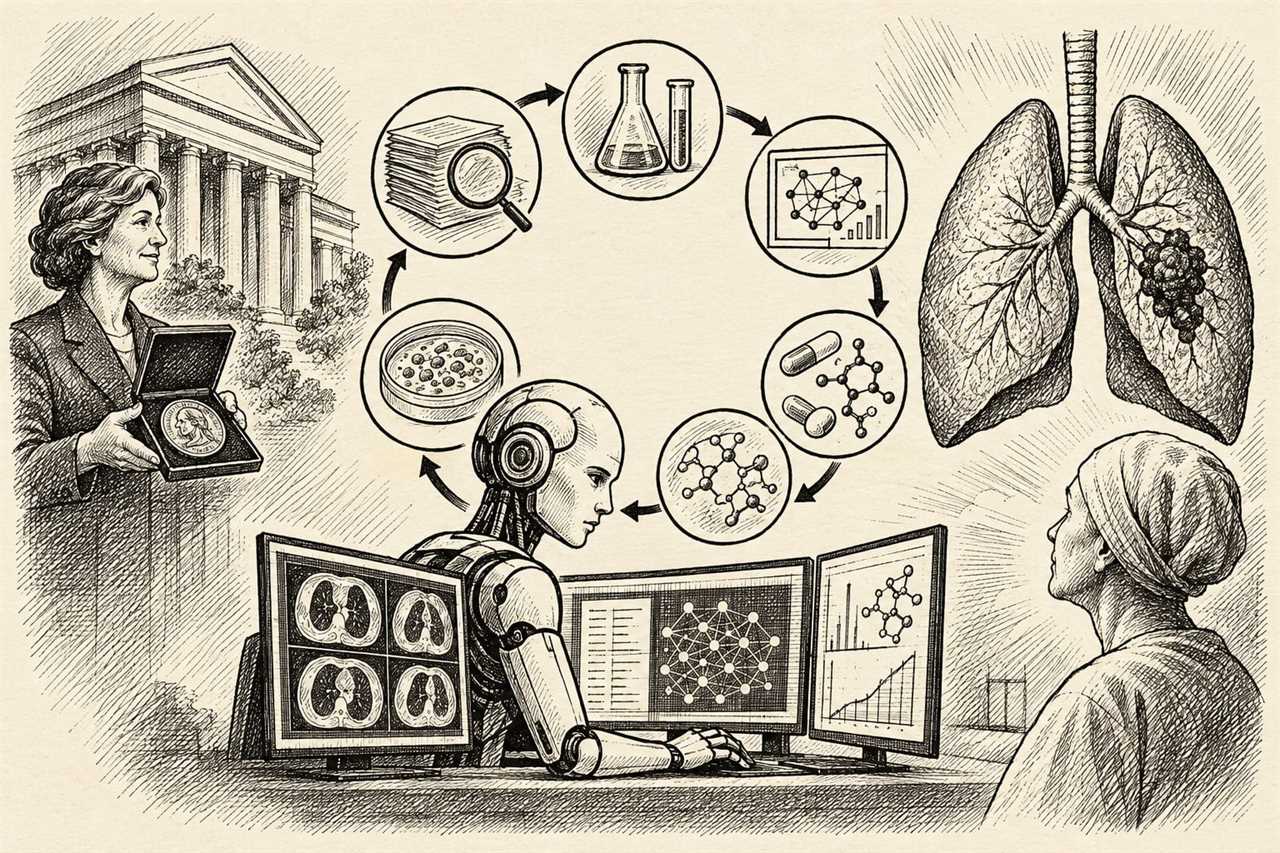
The system will combine large language model agents, the same category of technology underlying tools such as Claude or ChatGPT, with automated laboratory equipment capable of running hundreds to thousands of experiments at once, the report said. Rather than drawing primarily from published research, the platform will mine deidentified human data and molecular information from human cell and tissue samples to generate hypotheses about cancer biology. Candidate ideas will first be tested computationally using virtual tumors, AI models built from data describing how actual human cells respond to perturbation, before any idea advances to physical testing on robotics platforms working with human cells or organoids, the report noted.
Dr. Elemento said this design addresses two persistent limitations in biomedical research, according to the report. Earlier AI scientist efforts have relied on agents that read existing literature and propose hypotheses based on prior publications, an approach he considers useful but constrained, since the literature offers an indirect and sometimes incomplete picture of human biology. The second limitation, the report said, is the traditional practice of testing one hypothesis at a time in animal models, a slow and costly method whose findings do not always apply to human patients.
The workflow is designed to be cyclical, the report said: AI agents propose mechanisms, the robotics platform tests them in parallel, and each round of results feeds back into the AI, which uses the outcomes to determine subsequent experiments. Virtual tumors act as an intermediate screening step before laboratory resources are committed. As quoted in the report, Dr. Elemento said prediction is not discovery, and that the goal is a system that proposes, tests and revises biological mechanisms as scientists do, but faster and at greater scale than any human laboratory could achieve.
Human researchers will continue to oversee the system, the report said, setting research goals, dismissing unsupported hypotheses, and halting experiments judged too costly or unlikely to succeed, while also enforcing safety and ethical standards given the system's capacity to design and run its own experiments on human-derived material.
The project's initial focus on lung cancer stems from the scale of unmet need, the report said, citing American Cancer Society data showing an overall five-year survival rate below 3 in 10 for lung cancer patients, with early-stage disease especially difficult to manage. Dr. Elemento's team plans to study why only some early lung lesions, including ground-glass opacities visible on CT scans, progress to invasive cancer, aiming to identify intervention points at the earliest, most treatable stages. As quoted in the report, he said there is a genuine need to find new mechanisms that can be targeted with drugs, particularly early in the disease.
The Englander Institute has spent five years building infrastructure for this work, the report said, including a collection of more than 300 patient-derived organoid models across more than a dozen cancer types and a large dataset on the molecular and cellular features of lung cancer. Dr. Elemento said this foundation now makes it possible to let AI run the scientific process, with human oversight, toward major discoveries, according to the report.
Beyond lung cancer, the report said Dr. Elemento envisions expanding the platform to other cancers and developing specialized AI agents for distinct scientific roles, including hypothesis generation, critique, experimental design and data analysis, while also working to make the tools accessible to researchers without computational training. He described the effort, as quoted in the report, as an opportunity to change the scientific method itself after decades in which only instruments were upgraded.
This article was compiled from reporting published by Bioengineer.org, drawing on a release describing the Pioneer Award. The communications office of the organization that publishes this site regularly issues formal releases on developments in biomedical research and artificial intelligence applications in science.